
A managed AI receptionist is an AI that answers your phone, books jobs and captures leads, and a team that builds, connects and keeps tuning it for you. That second part matters. Most owners don't need another app to configure at 9 p.m. They need calls answered and appointments on the calendar. That's what our AI phone receptionist is built for: we do the hands-on implementation, you run the business.
TL;DR
- A managed AI receptionist answers calls, books appointments, qualifies leads and covers after-hours, while a provider sets it up and maintains it.
- It handles routine, structured calls well. Emergencies, upset callers and medical, legal or financial advice should go to a person.
- The real work is the setup: your calendar rules, your phone system, your customer records and a clear handoff path.
- Dental and medical clinics need to think about HIPAA, including a business associate agreement with any vendor that stores recordings or transcripts.
- Measure it: answer rate, booking rate, completed transfers, early hang-ups and data accuracy.
Table of Contents
- What "managed" actually means
- Which calls an AI receptionist handles well
- Where a person should take over
- Connecting it to your phone, calendar and records
- What it costs
- Extra care for dental and medical clinics
- If the AI calls out
- How to tell if it's working
- Our take
- Getting started with AI Agent Worx
- FAQ
- Sources
What "managed" actually means
There are two ways to get an AI receptionist. You can sign up for an answering app and build it yourself. Or you can hire someone to build it around how your business really runs and keep it working.
AI Agent Worx is the second kind. We specialize in done-for-you automation for small and mid-sized, owner-led businesses: practical implementation, not a slide deck of advice. If you want the side-by-side, we wrote one on a done-for-you AI receptionist versus a DIY answering app.
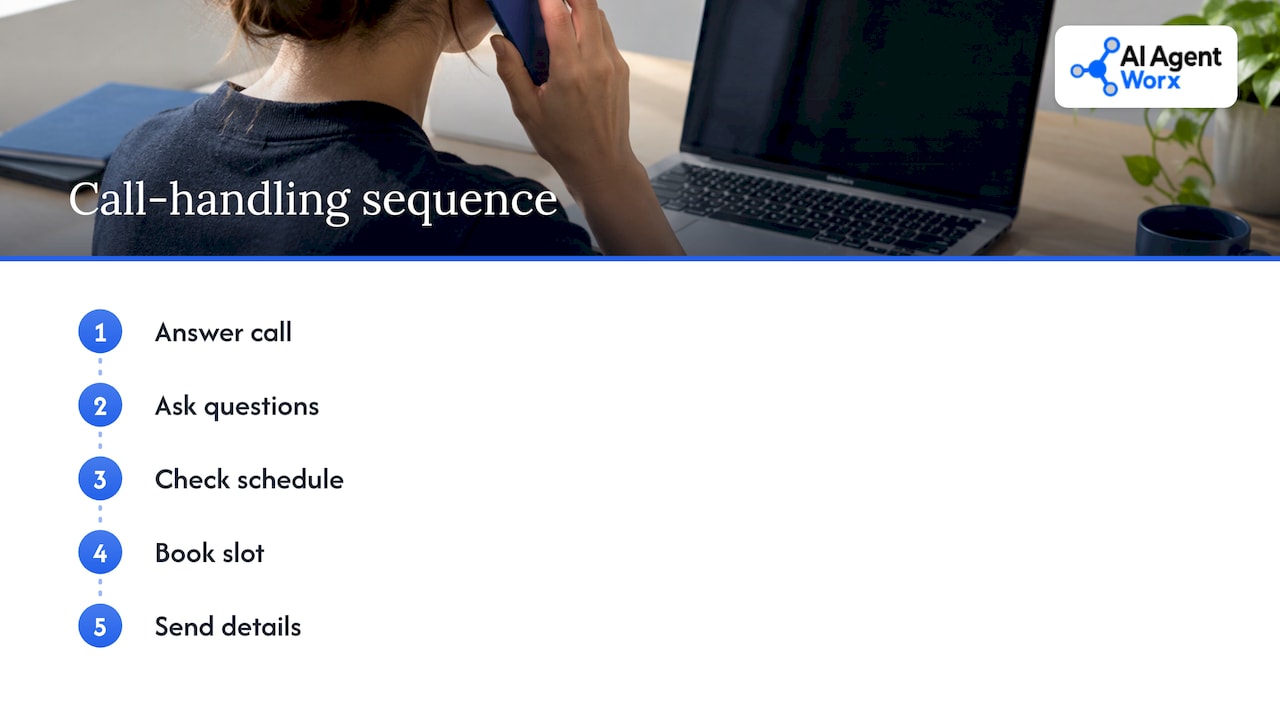
Why does that matter for a plumber, HVAC company, med spa or dental office? Because the phone is the front door. A missed call often becomes a call to your competitor. The job isn't just "pick up." It's pick up, ask the right questions, check the real schedule, book the right slot, and send the details where your team will see them. Every one of those links can break if nobody owns them.
Which calls an AI receptionist handles well
The AI Agent Report's reality-check on AI receptionists lists the routine work these systems do well:
- Answering hours and FAQ questions
- Booking appointments, as long as the calendar rules are clear
- Rescheduling and cancellations
- Lead intake with scripted qualification questions
- After-hours capture
- Filtering spam calls
That's most of what fills a front desk day. For a service business, it's the quote request at 7 p.m., the "can you come Thursday?" call while your crew is on a roof, and the reschedule from a regular customer.
Our practical guide to AI appointment booking goes deeper on the scheduling side.
Where a person should take over
The same report says AI alone is a poor fit for angry or distressed callers, emergencies, medical, legal or financial advice, and pricing that depends on a diagnosis. Communicate's October 2026 guide lands in a similar place: complaints, emergencies and complex custom pricing need a human.
So design the exit first. Before any call type goes live, decide:
- What words or situations trigger a transfer ("flooding," "chest pain," "I want to speak to the owner").
- Who gets the call, and what happens if they don't pick up.
- What the caller hears while it transfers.
- Where the notes go so nobody asks the caller to repeat themselves.
The same sources name the failure modes to plan around: invented answers, wrong bookings (wrong service, time or provider), failed escalation, and a knowledge base that drifts so the AI keeps quoting an old price. All of these are manageable with monitoring and a review habit. That review habit is exactly what "managed" covers, and it's the reason we stay on after launch instead of handing you a login.
Connecting it to your phone, calendar and records
This is where DIY setups stall. A receptionist that can't see your real availability is just a fancy voicemail. A working setup usually needs four connections:
- Phone system. Calls need to reach the AI (all of them, or only after hours, or when nobody answers) and be able to transfer out to a live person.
- Calendar. Rules about job length, service area, buffer time, which tech does what, and which slots stay closed.
- Customer records. New leads and booked jobs should land in your CRM, not in someone's inbox. Our CRM, messaging and nurture automation is for that follow-through.
- Follow-up workflows. Confirmation texts, reminders, and a nudge to leads who didn't book.
Owners often underestimate the calendar rules. "Book anything open" sounds simple until the AI books a three-hour install into a 30-minute gap. Writing down the real rules is the bulk of the work, and doing that with you is part of our AI phone receptionist service. If you want to know how long a rollout takes, see our piece on automated call answering rollouts in 2 to 4 weeks.
What it costs
Cost depends on call volume, how many systems we connect, and how much custom workflow you want. We don't publish a flat price for the receptionist, so the honest answer is that it's scoped after a discovery conversation. Our breakdown of what an AI receptionist costs a small business lays out the pieces: setup, monthly use and ongoing management. If you're weighing it against a live answering service, this comparison of AI and live answering shows where volume tips the math.
The cost question that matters more: what is one missed job worth to you? For a contractor, one booked repair or install can outweigh a lot of monthly fees. Our guide to recovering lost bookings with an AI phone receptionist walks through that thinking.
Extra care for dental and medical clinics
If you run a dental, medical or men's health clinic, calls contain protected health information (PHI), meaning health details tied to a patient. Two points from official guidance:
- HHS says in its audio-only telehealth guidance (last reviewed June 23, 2026) that a vendor who creates, receives or maintains PHI, for example by storing recordings or transcripts, needs a business associate agreement (BAA) with the covered clinic.
- The same guidance says VoIP, apps, electronic recordings, transcripts and stored audio messages can trigger HIPAA Security Rule safeguards and risk analysis, while a traditional landline service that doesn't transmit electronic PHI may fall outside it.
In plain terms: know what gets recorded, where it's stored, and who has signed what. Keep clinical questions out of the AI's lane and route them to your staff. For more on how data handling shapes a vendor's obligations, see this piece on AI ethics, data and policy. Your compliance officer or healthcare attorney should sign off on the final setup.
If the AI calls out
Inbound answering and outbound follow-up are different legal territory. The FCC's February 2, 2024 declaratory ruling says AI-generated human voices count as artificial or prerecorded voices under the Telephone Consumer Protection Act (TCPA). Outbound calls like that generally need prior express consent, and telemarketing calls need prior express written consent, unless an exception applies. Get consent language right on your forms before any AI voice dials a lead.
How to tell if it's working
Don't guess. Track a handful of numbers from week one. Lotus Libre's guide lists the operational ones:
| Metric | What it tells you |
|---|---|
| Answer rate | Are calls being picked up at all? |
| Booking rate | Are calls turning into appointments? |
| Completed transfers | Does the handoff to a person actually work? |
| Early hang-ups | Is the greeting or flow annoying callers? |
| Data accuracy | Are names, numbers, services and times right? |
Add two of your own: jobs booked from after-hours calls, and hours your staff no longer spend on the phone. Review call recordings or summaries weekly at first. Fix what drifts: a new price, a new service, a holiday schedule.
Our take
We see one mistake over and over in how owner-led businesses buy this: they treat it as a tool purchase. It's an operations job.
The AI voice is the easy part. The hard part is your calendar rules, your handoff plan, your follow-up and your records all agreeing with each other. That's why we build it for you and stay on. A receptionist that books wrong or quotes stale info costs you more than the missed call did.
Start with the calls that cost you the most: after-hours, while-on-a-job, and new-lead calls. Get those right, measure them, then widen. If you also want the leads that come in to get chased, we can tie in lead follow-up, CRM nurture and even your website and search visibility, so the phone isn't a standalone gadget.
Brian
Getting started with AI Agent Worx
Our AI phone receptionist answers calls, schedules appointments and follows up with leads, and we tailor it to the bottlenecks of your business rather than handing you a generic template. It starts with a discovery consultation about your calls, your calendar and your team.

See the AI phone receptionist page, or browse all our services, including lead generation, workflow automation and SEO.
FAQ
Is a managed AI receptionist the same as an answering service?
No. A live answering service uses people to take messages. A managed AI receptionist uses AI to answer, book and qualify, and a provider builds and maintains it. It can transfer to a person when a call needs one.
Can it book directly into my calendar?
Yes, when the calendar rules are clear: job length, service area, availability and who handles what. The setup work is defining those rules and connecting the calendar so the AI sees real openings.
What should I never let it handle alone?
Emergencies, upset callers, and medical, legal or financial advice. Set up a transfer path for these before going live.
Do clinics need anything special for HIPAA?
If a vendor stores recordings or transcripts containing PHI, HHS guidance says a business associate agreement is required with the clinic. Talk to your compliance lead or healthcare attorney before launch.
How fast can it go live?
It depends on how many systems we connect and how clear your rules are. Our write-up on automated call answering rollouts covers typical timelines for small businesses.
Sources
- What Is an AI Receptionist? Uses, Costs and Limits (The AI Agent Report)
- AI receptionist for small business: costs and limits (Communicate)
- AI Receptionist: 24/7 Call Answering and Booking Guide (Lotus Libre)
- HHS: HIPAA and audio-only telehealth guidance
- FCC: Implications of Artificial Intelligence Technologies on TCPA (FCC 24-17)
- AI Ethics in Training: Data, People and Policy