
Most small businesses land between $30 and $300 a month for an AI receptionist, with the biggest swing factor being how many minutes or calls your plan includes versus what you actually use. Pure AI plans stay cheap because software doesn't clock overtime. The one number to pull before you shop: your average monthly call volume and average call length. Get that, and pricing math gets simple fast.
TL;DR:
- Small businesses usually spend between $30 and $300 monthly on AI receptionists, with cost strongly influenced by call volume and length.
- Entry-tier pure AI plans typically cost $39 to $99 a month, while hybrid plans with human escalation often range in the low hundreds.
- Billing methods vary from per-minute, per-call, flat-rate, to bundled plans, so knowing your call data helps compare vendors effectively.
- Overages can significantly increase costs, so requesting exact overage rates and avoiding long-term contracts with automatic upgrades is crucial.
- For high call volumes, flat-rate unlimited plans of $280 to $350 a month generally offer the best value and predictability.
Table of Contents
- How Much Is an AI Receptionist Across Different Tiers?
- How Do Per-Minute, Per-Call, and Flat-Rate Plans Work?
- What Drives Your All-In Monthly Cost?
- What Does an AI Receptionist Cost Look Like in Real Numbers?
- How Do You Pick the Right Plan and Question Vendors Correctly?
- Why Implementation Determines Your Real Cost
- How Aiagentworx Builds AI Receptionists Around Your Real Call Volume
- Sources
- FAQ
How Much Is an AI Receptionist Across Different Tiers?
Pricing splits into three clear bands, and knowing which one you're shopping in saves you from comparing apples to phone trees.
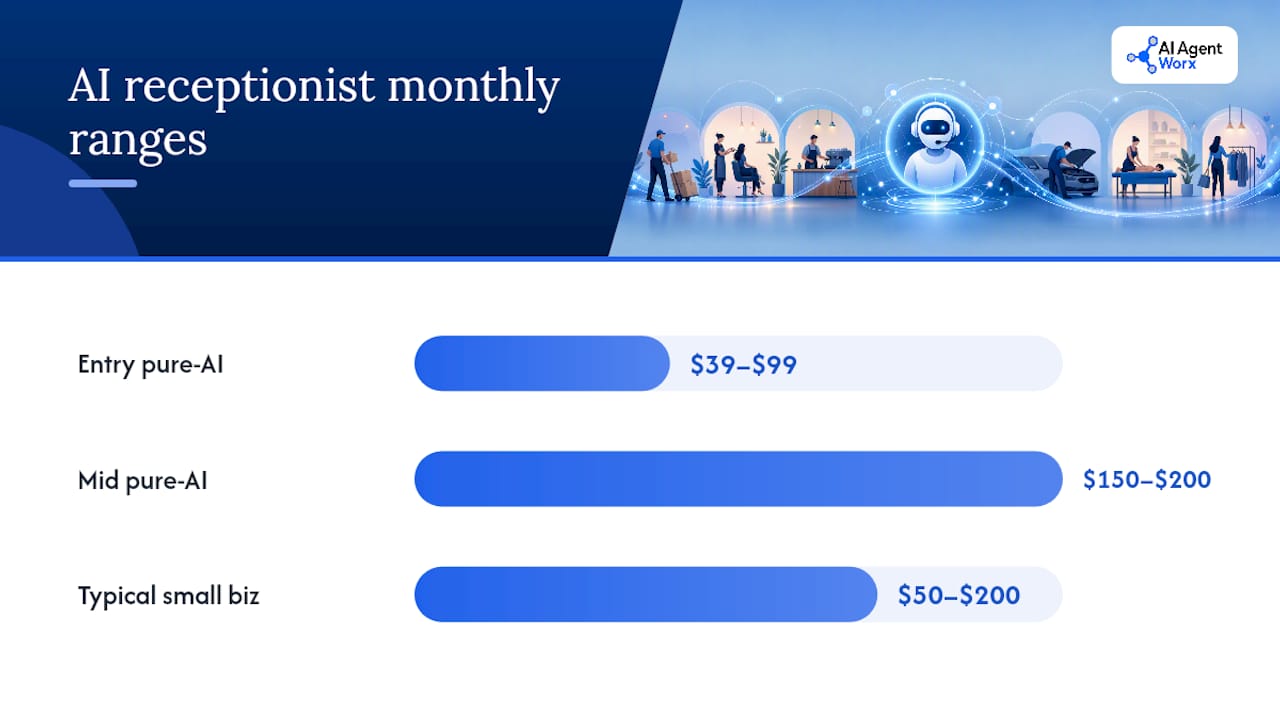
Pure-AI plans sit at the bottom. Entry tiers typically run $39 to $99 a month, covering call answering, basic routing, and a set number of included minutes or calls. Mid-tier pure-AI plans push toward $150 to $200 monthly once you add booking integrations or multi-line support, according to DialPhone's 2026 pricing survey.
Hybrid plans, where AI handles routine calls and humans step in for escalations, cost more because you're paying for both infrastructure and labor on standby. Expect prices roughly in the low hundreds monthly, per the same DialPhone data. The jump makes sense: every escalated call now touches a paid human, and that changes the unit economics completely.
Live-only receptionist services, the traditional model with a person answering every call, often start in the mid-hundreds of dollars per month and climb from there depending on hours covered. They still win in a few specific spots:
- High-stakes intake calls where tone and judgment matter more than speed
- Legal or medical front desks needing nuanced triage
- Businesses with unpredictable, highly emotional caller situations
For context, CloudTalk's pricing analysis puts the realistic range most small businesses land in at $50 to $200 a month once you account for the plan mix that actually fits typical call patterns. That's your baseline. Everything else is customization.
How Do Per-Minute, Per-Call, and Flat-Rate Plans Work?
Vendors bill you one of four ways, and each one rewards a different kind of business.
- Per-minute billing multiplies your total monthly minutes by a rate, typically $0.15 to $0.50 per minute for AI according to Kea AI's cost calculator. A business with 300 minutes a month at $0.30 pays $90. Simple, but it punishes long calls.
- Per-call billing charges a flat fee per answered call regardless of length. This works well if your calls are consistently short, but a single 15-minute call costs the same as a 30-second one, so average call length still matters when comparing vendors.
- Flat-rate or unlimited plans charge one monthly fee no matter how many calls come in. You pay more upfront but never see a surprise overage line item.
Here's the arithmetic that actually matters: once you convert your call logs into total minutes per month, comparing any two vendors stops being guesswork and becomes a spreadsheet problem. Pull your last three months of call data before you request a single quote.
What Drives Your All-In Monthly Cost?
Two variables move the needle more than anything else: call volume and average call length. A business fielding 200 calls a month at 2 minutes each uses 400 minutes. Double the average call length and you've doubled your bill without adding a single new caller.
Beyond volume, watch these cost levers:
- Feature add-ons like appointment booking, payment processing, CRM sync, and SMS follow-up each carry their own fee, often $10 to $50 a month per feature
- Setup and onboarding charges range from $0 to $500 depending on how much custom scripting and number porting the vendor handles
- Compliance surcharges apply if you need a Business Associate Agreement for healthcare use, adding a HIPAA compliance line to your invoice
- Contract minimums lock you into 6 or 12 months, sometimes with auto-upgrade clauses that bump your tier if you exceed minutes twice
- Overage rates for exceeding your bundle can run $0.35 to $1.79 or more per minute, based on DialPhone's vendor data
Pro Tip: Ask every vendor for their overage rate in writing before signing anything. A cheap base price with a punishing overage rate can cost you more than a higher flat-rate plan by month three.
Red flags worth walking away from: vendors who won't quote a specific overage number, contracts with automatic tier upgrades you can't decline, and minimum terms longer than 12 months for a service you haven't tested yet.
What Does an AI Receptionist Cost Look Like in Real Numbers?
Numbers make this concrete. Here's how three different call volumes shake out.
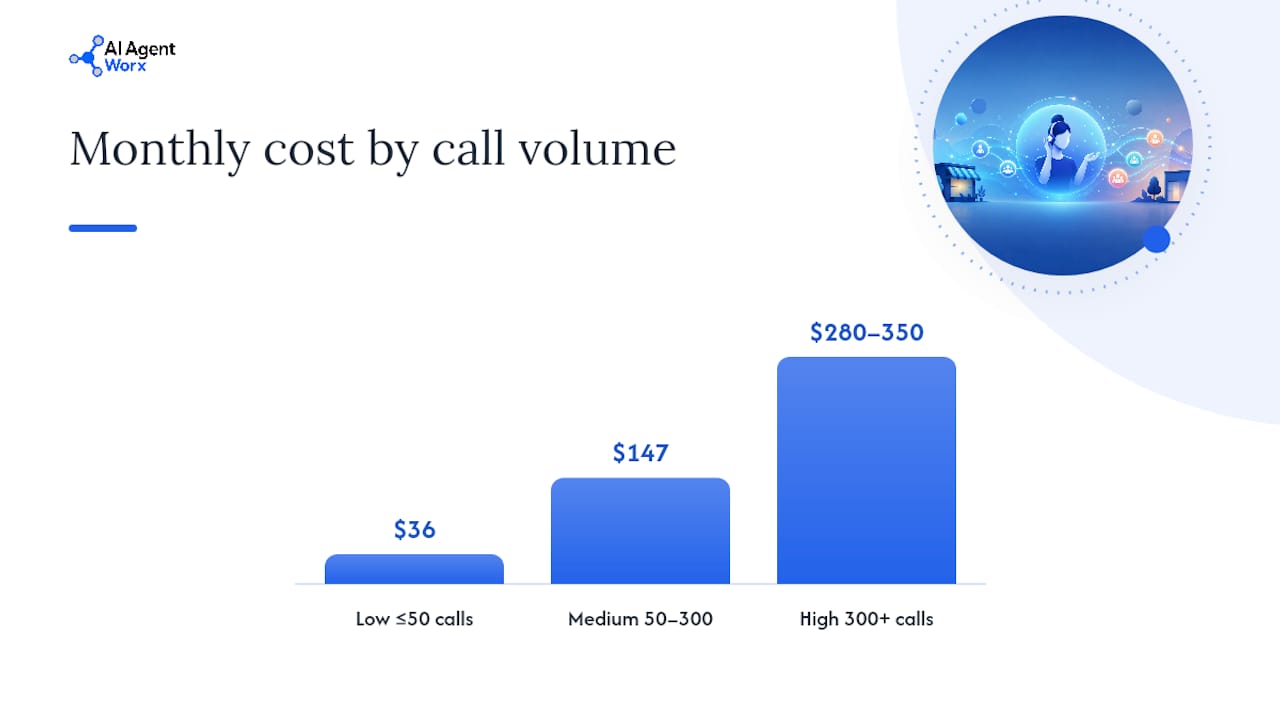
- Under 50 calls a month. A dental office averaging 40 calls, each 3 minutes, uses 120 minutes monthly. At $0.30 per minute, that's $36, likely covered entirely by an entry-tier plan costing around $39 to $59 a month. A flat-rate plan here would be overkill.
- 50 to 300 calls a month. A home services company handling 180 calls averaging 4 minutes runs 720 minutes. A mid-tier plan with 600 included minutes at $99 a month, plus 120 overage minutes at $0.40 each, adds $48. Total: $147 a month, all in.
- 300+ calls a month. A multi-location clinic fielding 500 calls at 3.5 minutes averages 1,750 minutes monthly. Metered billing at a few dimes per minute could run several hundred dollars monthly. A flat-rate unlimited plan at $280 to $350 a month wins decisively here, which is exactly why flat plans exist for high-volume operations.
The ROI math is where this gets interesting. If your AI receptionist costs $150 a month and recovers just one missed call that converts to a $200 service appointment, you've already broken even. DialPhone's ROI case data shows small service businesses often hit break-even at fewer than 10 recovered calls a month.
Compare that to labor. The Bureau of Labor Statistics tracks median receptionist wages that, once you add payroll taxes and benefits, put a single full-time front-desk hire costs substantially more than most AI plans cost annually. That gap is the whole business case in one sentence.
How Do You Pick the Right Plan and Question Vendors Correctly?
Start with data, not vendor calls. Pull three numbers from your phone system: total monthly calls, average call length, and how many calls you're currently missing. That trio tells you which tier you belong in before a single sales rep opens their mouth.
When you do get on a call with a vendor, ask these directly:
- How many minutes or calls are included, and what's the exact overage rate?
- Who handles number porting, and is there a fee?
- Do you sign a BAA for HIPAA compliance, and does that carry a surcharge?
- What does custom scripting cost beyond the default script?
- Is there a service-level agreement for uptime or response accuracy?
Pro Tip: If a vendor hesitates to give you a straight number on overage rates or setup fees, treat that as your answer. The clearest pricing pages tend to belong to the most transparent companies.
Match your decision to your actual need. Simple call routing and message-taking fits an entry-tier pure-AI plan. Appointment booking with payment collection pushes you toward mid-tier or hybrid. High-stakes triage still leans human. Negotiate contract length down whenever a vendor offers a longer term for a discount. It's rarely worth the lock-in for a service you haven't run for a full billing cycle yet.
Why Implementation Determines Your Real Cost
Sticker price tells you almost nothing about what you'll actually pay by month six. The businesses that get surprised by overages are almost always the ones that let a generic script and default routing run unchecked from day one.
Custom call routing, tight CRM integration, and a script trimmed to your actual customer questions cut wasted minutes fast with AI chat assistants and integrations. A typical small-business engagement runs through discovery, where we map your real call patterns, then a build phase, then ongoing tuning. That sequence is what keeps the invoice matching the quote.
— Brian
How Aiagentworx Builds AI Receptionists Around Your Real Call Volume
Most pricing pages quote you a number based on average customers. Some AI receptionist providers build around your actual call volume and average call length from day one, so you're not paying for 500 minutes when you use 200, or getting blindsided by overage fees when you use 600.

Our AI phone receptionist setup includes custom scripting, number porting, and direct appointment scheduling integration, plus CRM sync so every call logs where your team already works. The engagement moves through a discovery call, a build phase tailored to your workflow, and ongoing support that adjusts routing as your call patterns shift.
Before you book a discovery call, pull your last three months of call logs: total calls, average length, and missed-call count. That's all we need to quote you a plan that fits, not a generic tier. Check out our full services overview or reach out directly to talk through your numbers.
Sources
- Bureau of Labor Statistics — Receptionists and information clerks
- Best AI Phone Answering Service Cost Calculator 2026 — Kea AI
FAQ
How Much Should I Charge for an AI Receptionist?
If you're comparing quotes as a buyer, expect entry-tier pure-AI plans priced generally under one hundred dollars per month and hybrid plans at somewhat higher monthly price brackets, based on published 2026 vendor pricing from DialPhone.
Is an AI Receptionist Worth It?
For most call volumes under a few hundred calls a month, yes. Break-even often happens at fewer than 10 recovered calls a month for service businesses, according to DialPhone's ROI data, and Aiagentworx's implementation approach is built to hit that quickly by tuning routing to your actual call patterns.
How Much Does AI Reception Cost?
Most small businesses pay a few tens to a couple hundred dollars monthly all in, per CloudTalk's pricing analysis, though higher-volume operations on flat-rate plans pay toward the upper end of that range.
How Much Do Virtual Receptionists Cost?
Live-only virtual receptionist services typically start in the mid-hundreds of dollars per month, while AI-only options start in the lower tens to just under one hundred dollars per month, with hybrid plans bridging the gap at intermediate price levels.