
AI phone answering for a small business usually costs a small fraction of a front-desk hire. The monthly fee is only part of the bill, though. The setup work, the per-minute or per-call overage charges, and who keeps the thing running decide what you actually pay. A do-it-yourself app can look cheap and still eat your evenings. A done-for-you setup costs more up front, but you stop being the person who writes the call script, wires up the calendar and fixes it when it breaks. That's what we build at AI Agent Worx, and below we show how to price it, what to compare, and how to tell if it will pay for itself at your call volume.
TL;DR
- Most AI answering plans bill one of three ways: a flat monthly fee, a bundle of calls or minutes with overage, or a pure per-minute rate. Your real cost depends on call volume and call length.
- The sticker price leaves out setup: scripts, calendar connection, testing and ongoing tuning. That time (yours or someone else's) is the hidden line item.
- A full-time receptionist is far more expensive. BLS puts the median receptionist wage at $18.27 an hour before benefits, payroll taxes and coverage gaps.
- The break-even test is simple: what does one missed call cost you, and how many do you miss a month?
- At AI Agent Worx we don't publish a price for the AI Phone Receptionist. We scope it to your business in a discovery consultation.
Table of Contents
- The three ways AI phone answering is priced
- What the monthly fee leaves out
- How AI answering compares with a live service or a hire
- A quick worked example
- Done-for-you versus DIY: what changes the total
- What to ask any provider before you compare prices
- Can you get it for free?
- Our perspective
- Getting a number for your business
- FAQ
- Sources
The three ways AI phone answering is priced
Before you compare any quotes, work out which billing model each one uses. Two plans with the same headline number can land far apart on your invoice.
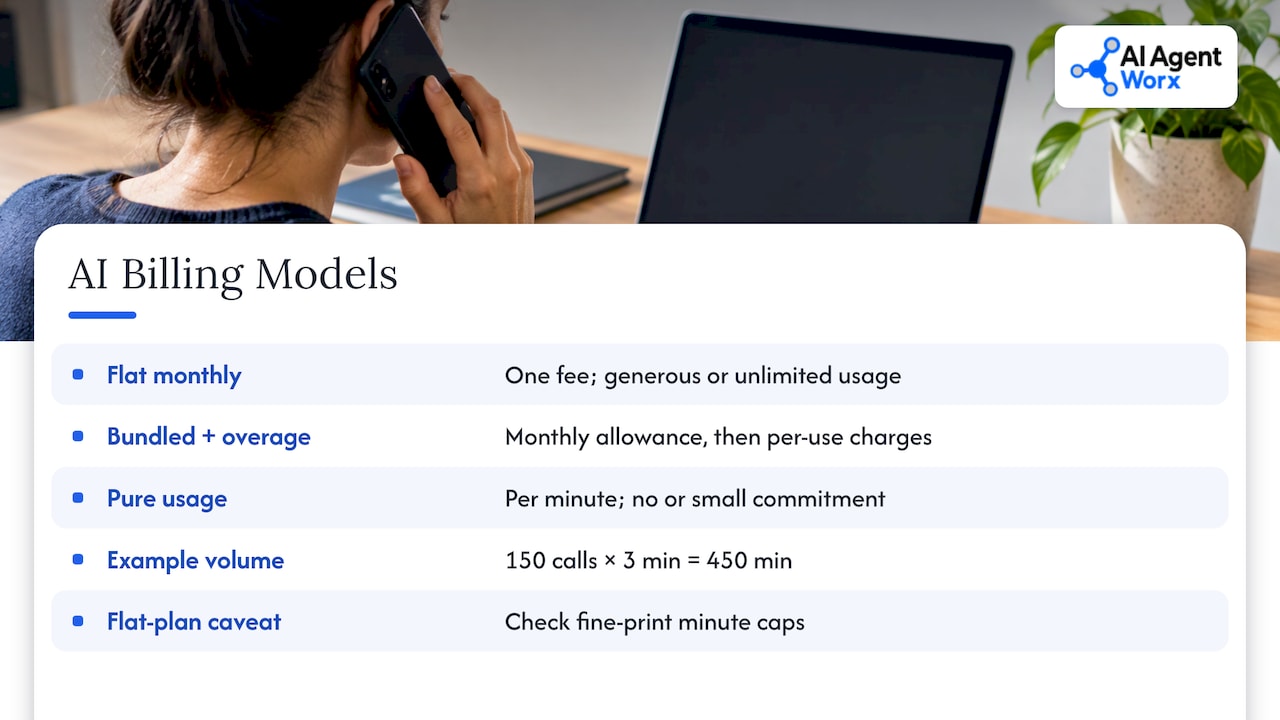
Flat monthly fee. You pay one amount and get unlimited or generous usage. This is the easiest to budget. Check what "unlimited" means, because some plans cap minutes in the fine print.
Bundled calls or minutes plus overage. You get, say, a set number of calls or minutes each month, and anything beyond that is billed per call or per minute. This is the most common model, and the overage rate is where budgets slip. A slow month looks great. A busy month, the one where you most need the phone answered, costs more.
Pure usage. You pay per minute of conversation with no monthly commitment, or a very small one. It's cheap at low volume and unpredictable at high volume.
A quick way to compare: convert every quote to a cost per call at your own volume. If you get 150 calls a month and an average call runs three minutes, that's 450 minutes. Price each plan against 450 minutes, not against the example in its marketing.
What the monthly fee leaves out
Setup time
An AI receptionist only sounds good if someone tells it what your business does. That means writing the greeting, the answers to your ten most common questions, your hours, your service area, what to do with emergencies, and when to transfer to a human. Then it has to connect to your calendar or booking tool and be tested with real call scenarios.
One published pricing guide from November 2026 puts build-it-yourself AI phone platforms at roughly $15 to $40 a month for 300 minutes of calls and ready-made receptionist apps at $39 to $149 a month, and it names setup time as the real hidden cost. We'd agree with the diagnosis, whatever the exact figures turn out to be when you shop. If your time is worth $75 an hour and setup and tuning take ten hours, that's $750 you never saw on the pricing page.
Overage and add-ons
Look for charges on:
- calls or minutes above the bundle
- extra phone numbers or locations
- transfers to a live person
- texting follow-ups
- CRM or calendar integrations on a higher tier
- call recordings and transcripts kept past a set period
None of these is unreasonable. They just need to be in your math before you sign.
Maintenance
Your business changes. Prices change, you add a service, you close for a holiday, you hire a second technician. Someone has to update the receptionist. With a self-serve app, that someone is you. Ask any provider who makes those changes and how quickly.
How AI answering compares with a live service or a hire
The comparison most owners are really making is not AI against nothing. It's AI against a person.
Hiring a receptionist
The Bureau of Labor Statistics reports a median hourly wage of $18.27 for receptionists in May 2025, which works out to $38,010 a year. That's wages only. It leaves out payroll taxes, benefits, training, sick days and vacation, and it covers a standard week. Nights and weekends are not covered at all.
Here's what that means in practice. A receptionist on a 40-hour week is at the desk for roughly a quarter of the 168 hours in a week. Your phone rings the other three quarters of the time too. For appointment-driven businesses like dental and medical clinics, trades and men's health clinics, a lot of calls arrive at lunch, early evening and on weekends, exactly when the desk is empty or busy with a patient.
Live answering services
Live answering services typically bill by the minute or the call, and their plans scale with volume. They cover after-hours well, and a person picks up. The cost climbs fast as call counts rise, because every minute is a human minute. If most of your calls are routine (hours, location, "can I book Tuesday?"), you're paying human rates for repetitive work.
We've written a separate breakdown of the crossover point in when AI beats live answering on cost. The short version is that once your monthly minutes pass a modest threshold, the AI side wins for routine calls.
Where AI fits
AI answering is built for the repetitive, high-volume part of the phone: answer instantly, every time, collect the caller's details, book or route, and send you a summary. It doesn't call in sick and it doesn't put anyone on hold. For most small businesses that makes it the cheapest way to get every call answered, at every hour.
A quick worked example
Say you run a two-chair dental practice. You get about 200 calls a month. About 60 of them land outside business hours or while the front desk is with a patient. Half of those callers leave no voicemail and book somewhere else.
That's about 30 lost contacts a month. If one in three would have booked and a new patient is worth $400 in first-year revenue (use your own number), you're losing around $4,000 a month. Not every one of those calls is a real loss, so cut it in half to be conservative: $2,000.
Now the question isn't "is $X a month too much?" It's "does answering those calls recover more than $X?" Even a modest recovery rate makes most AI answering budgets look small. The same math works for a plumber, where one emergency job can be worth several hundred dollars, or a men's health clinic, where a consult request that goes unanswered is a patient who calls the next clinic.
Do this with your own numbers:
- Count missed and abandoned calls for a month. Your phone carrier's call log shows them.
- Estimate the share that would have become a booking.
- Multiply by your average first-booking value.
- Compare that figure with the full monthly cost, including setup time.
If the recovered revenue is clearly above the total cost, it pays for itself. If your missed-call count is tiny, your best move may be to improve the way calls are handled before adding technology.
Done-for-you versus DIY: what changes the total
There are two broad ways to get an AI receptionist. You can subscribe to an app and configure it yourself. Or you can have someone build and manage it for you.
The DIY route has a lower monthly number and a higher time cost. You write the prompts, connect the tools, test the calls, and fix problems. If you enjoy that and have the hours, fine. Most owner-led businesses don't have the hours, and a half-tuned receptionist that mishandles a few calls a week quietly costs more than it saves.
The done-for-you route is where we work. AI Agent Worx focuses on hands-on implementation rather than advice: we build custom systems for the specific bottlenecks of owner-led businesses and provide ongoing support. For the phone, that means the receptionist is set up around how your business actually takes calls, and the work of building it and maintaining it isn't yours. We've compared the two approaches in done-for-you AI receptionist vs. DIY answering app, and our all-in AI receptionist cost guide lays out the budget range for small businesses.
If you do want to understand the build-it-yourself platform side first, this overview of voice AI agents explains how configurable voice agents work and where they sit next to packaged receptionist apps.
What to ask any provider before you compare prices
Use this list when you get quotes, ours included.
- What exactly is billed? Minutes, calls, seats, or a flat fee?
- What happens at the cap? Overage rate, or does the service stop answering?
- Who builds the call flow and who updates it?
- What does it connect to? Your calendar, CRM, texting, payment or intake forms.
- What happens when a call is urgent or the caller wants a person? Transfer rules should be yours to set.
- What do I get after each call? A summary, a transcript, a text or email alert.
- Is there a contract term? And what are the fees for changing it?
For clinics, add one more: how patient information is handled. Healthcare practices in the US need to think about HIPAA when calls involve protected health information. Ask how the provider handles it before you go live, and loop in your compliance contact or attorney if you aren't sure what your practice requires.
Can you get it for free?
Some platforms offer free tiers or trial periods, usually capped at a small number of calls. That works for hearing a demo and seeing how an AI voice sounds. A cap of a couple dozen calls a month won't cover a working business line, and a free plan usually leaves the setup entirely to you. Treat free tiers as a way to hear the technology, and price your real plan at your real volume.
Our perspective
Most owners we talk to don't have a phone problem. They have a "nobody picks up when I'm busy" problem. The cost question comes second.
We'd rather you compare total cost than monthly price. A cheap app that you have to build, test and babysit isn't cheap if it takes your Sunday. A properly built receptionist should handle the routine stuff, book the appointment, capture the lead and get out of the way.
That's why we do the implementation ourselves. We build around how your business takes calls: your hours, your services, your calendar, your rules for when a human should step in. Then we stay on to support it. It's the same approach we take for scheduling, follow-ups and CRM automation, because a phone call is only the first step. What happens after the call is where revenue actually lands.
Our advice: count your missed calls for one month, put a dollar value on them, and then ask any provider to price against that number. If the math works, it should be an easy yes.
Brian
Getting a number for your business
Our AI Phone Receptionist is built and managed for you, and we don't publish a standard price for it. The cost depends on your call volume, your hours, and what the receptionist needs to connect to, so we scope it in a discovery consultation. Come with your missed-call count and your average booking value and we can work out quickly whether it makes sense.

See how the AI Phone Receptionist works, or look at the full list of what we build on our services page. If you're mainly worried about nights and weekends, our after-hours call answering checklist is a good place to start.
FAQ
How much does AI phone answering cost for a small business?
Self-serve apps generally run from tens of dollars to a few hundred a month, depending on call volume and features. A done-for-you build is scoped to your business, so the number depends on call volume, hours and integrations. Always price against your own monthly minutes, plus setup time.
Is AI phone answering cheaper than a receptionist?
For routine calls, almost always. BLS reports a median receptionist wage of $18.27 an hour in May 2025 before benefits, and that covers one shift. An AI receptionist answers around the clock at a fraction of that cost.
What are the hidden costs?
Setup time, overage fees once you pass your bundle, extra charges for integrations or additional numbers, and the ongoing work of updating the call flow. A done-for-you service takes the setup and updates off your plate.
How do I know if it will pay for itself?
Multiply your monthly missed calls by the share that would have booked and by your average first-booking value. If that recovered revenue clearly exceeds the total monthly cost, it pays for itself. Your carrier's call log gives you the missed-call count.
Sources
- Receptionists, Occupational Outlook Handbook, U.S. Bureau of Labor Statistics
- AI receptionist cost for a small business (Nov 2026 prices), Henchbots
- Voice AI agent overview, BRDGIT