
A website conversion audit for owner-led businesses means checking what happens between a form submission and a booked appointment, not tweaking button colors. Run this: pull your 10 most recent leads and trace each one from form to calendar. Wherever you hit a manual step (someone copying an email into a spreadsheet, a lead sitting in an inbox), that's your first fix. Specialized providers build this kind of fix for a living, so you don't have to.
TL;DR:
- Ensuring immediate scheduling and webhook-based CRM intake can increase booked appointments by roughly 40 percent in service businesses.
- Mapping all lead touchpoints and verifying tracking accuracy helps identify workflow gaps that cause leads to stall or get lost in handoff.
- Fixing speed-to-lead by automating instant responses and scheduling is the most cost-effective way to improve conversion rates quickly.
- Most lost leads occur during manual handoffs due to field mismatches, routing to "the team," or delays in CRM synchronization rather than page design issues.
- A done-for-you automation system can effectively replace hiring a sales operations team, with deployment often completed within a couple of weeks.
Table of Contents
- What a Website Conversion Audit Actually Covers
- The 5-Step Audit Checklist You Can Run This Week
- Where Leads Actually Die: The Seams Nobody's Watching
- The Fixes That Actually Move the Needle First
- Choosing How to Build It: No-Code, Webhooks, or Done-for-You
- How to Verify the Fix Actually Worked
- What Fifteen Years of Watching Businesses Lose Leads Taught Me
- Get Your Handoffs Fixed Without Hiring Anyone
- Sources
- FAQ
What a Website Conversion Audit Actually Covers
Forget heatmaps and headline copy for a second. This kind of audit looks at lead capture, CRM handoffs, routing logic, scheduling, follow-up sequences, and whether you're grabbing billing details (service type, scope, budget) at the moment someone raises their hand. That's a different animal from a UX or CRO audit, which lives on the page itself.
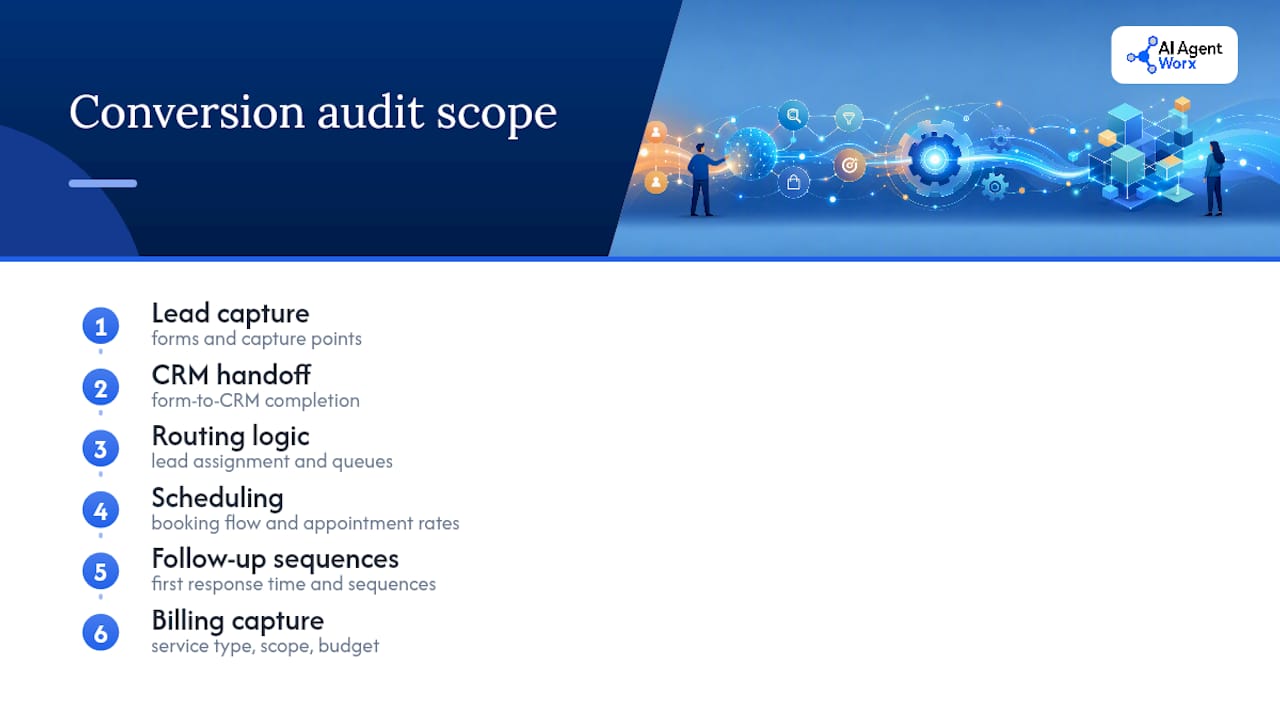
Here's why the seams matter more than the page for owner-led shops: you don't have a sales ops team catching the ball when a form submits. If a lead lands in an inbox and sits there for six hours, that's not a UX problem. It's a workflow gap, and it's invisible until you go looking for it. The conversion events that matter here aren't clicks, they're form-to-CRM completion, first response time, and booked-to-kept appointment rate.
The 5-Step Audit Checklist You Can Run This Week
Run these five steps in order. Skipping "measure" to jump straight to "fix" is how people patch the wrong thing.
- Map. List every front-end touchpoint (contact form, booking widget, phone line) and where it's supposed to land (CRM, calendar, invoicing tool).
- Measure. Confirm your tracking actually fires and that you have one source of truth for contacts, not three half-synced spreadsheets. This step matters enough that no serious conversion rate optimization audit skips validating tracking before touching anything else.
- Reproduce. Submit test leads and trace 10 real recent ones end-to-end. Write down exactly where each one stalled.
- Fix. Prioritize by revenue impact versus effort. Capturing billing fields at intake and switching to instant scheduling usually pay off first.
- Verify. Run a two-week test window and watch the numbers move before declaring victory.
Pro Tip: Don't audit your whole funnel at once. Pick your single highest-volume lead path, usually the contact form, and run these five steps on that one path first.
Where Leads Actually Die: The Seams Nobody's Watching
Most lost leads don't disappear at the ad or the landing page. They die in the handoff.
- Field mismatches. Your form asks for "project type" and your CRM has no matching field, so the data drops silently on import.
- Human queues. Anything routed to "the team" instead of a named owner sits until someone happens to check.
- Email-only capture. A form that just emails you creates duplicate contact records and no searchable history the moment a second person touches it.
- Sync lag. A 20-minute delay between form and CRM means your nurture sequence starts late and your qualification data is stale by the time anyone reads it.
A 15-point conversion audit makes the same point from the other direction: fast, automated follow-up is what keeps a lead warm, and a five-minute response window changes qualification odds dramatically. Log every failure you find with a timestamp and a dollar estimate. That log becomes your fix priority list.
The Fixes That Actually Move the Needle First
Not every fix deserves your first week. These do.
- Instant scheduling instead of a thank-you page. The moment a lead qualifies, hand them a calendar, not a "we'll be in touch."
- Webhook or API intake. This preserves every field your form collects instead of losing structure through a generic email notification, and it sets you up for invoice-ready data later.
- Automated reschedule and no-show sequences. A missed appointment shouldn't require a human to notice and follow up.
- Billing-relevant fields captured at intake. Service type, scope, and rough budget collected upfront eliminate the manual back-and-forth that delays your first invoice.
- Named ownership on every handoff, with exception alerts. "Routed to the team" is the single most common way leads quietly disappear.
Pro Tip: If you only fix one thing this month, fix speed-to-lead. Automated instant response and scheduling can lift booked appointments by roughly 40% for service businesses, and it's usually the cheapest change on this list.
Choosing How to Build It: No-Code, Webhooks, or Done-for-You
You've got three real paths here, and picking the wrong one wastes months.
- No-code tools (Zapier, Make). Fast to set up, cheap to test, and genuinely fine for proving a workflow works. They get fragile fast once volume climbs or field mapping gets complicated.
- Webhook or API intake. More setup work, usually a developer, but you get server-side validation and clean, invoice-ready field mapping that doesn't fall apart under volume.
- Hybrid. Validate the workflow with no-code first, then harden the high-volume paths with webhooks once you know they're worth the investment.
If you don't have the bandwidth to babysit any of this, a done-for-you provider like Aiagentworx maps the workflow, builds the automation, and monitors it, which is usually the right call once you're spending more hours managing the fix than the fix saves you.
How to Verify the Fix Actually Worked
Two numbers tell you almost everything: qualified-to-booked rate and speed-to-lead. Top-decile companies book 78% or more of qualified leads, while the median companies book just over half of qualified leads. If your booking rate is noticeably below the median, you've found your gap.
The benchmark that matters: top performers book 78%+ of qualified leads to appointments; the median company books 62%. That 16-point gap is almost always a routing and follow-up problem, not a traffic problem.
Track speed-to-lead in minutes, not hours. Run automation health checks weekly: failed webhook deliveries, duplicate contact records, and sync lag between form and CRM. Test on a sample of at least 10 to 20 leads over two weeks before you call a fix successful.
What Fifteen Years of Watching Businesses Lose Leads Taught Me
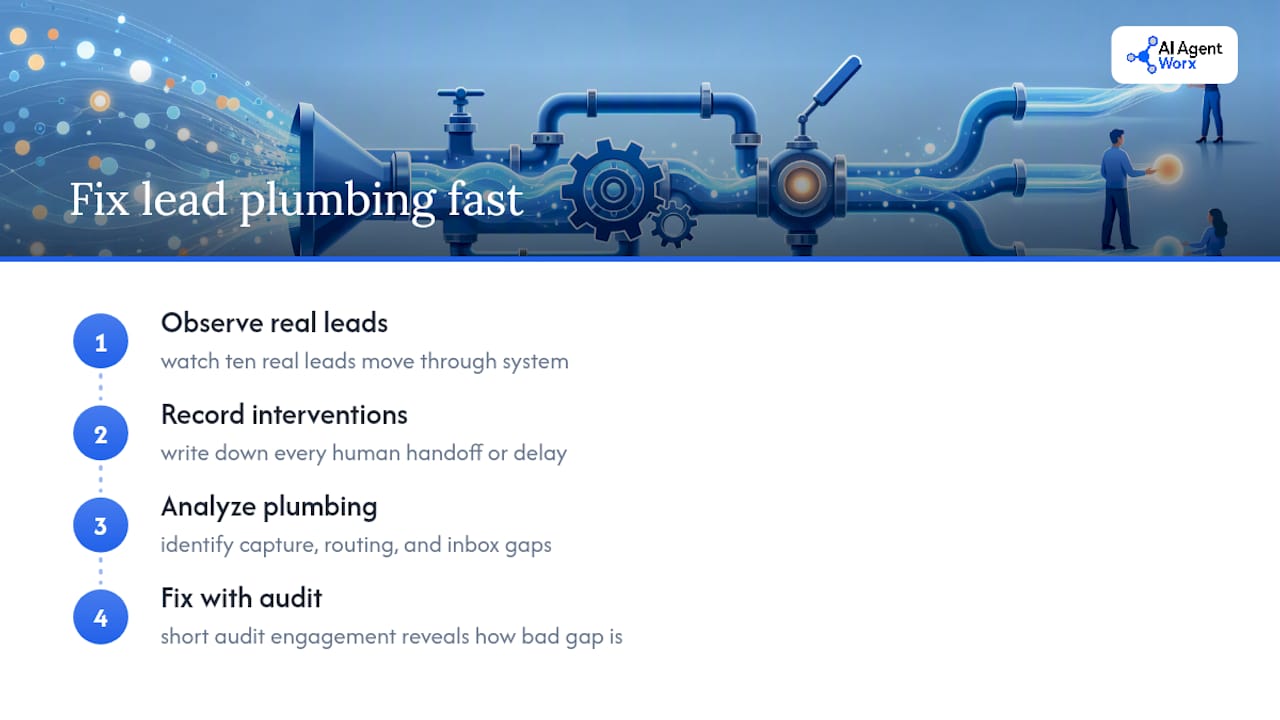
Most owners assume their website has a traffic problem or a design problem. It usually doesn't. It has a plumbing problem, and plumbing problems are boring, so they never get fixed. Everyone wants to talk about the landing page headline. Almost nobody wants to talk about the fact that a qualified lead sat in someone's inbox for four hours on a Tuesday.
Here's the uncomfortable part: the conventional CRO playbook, test your headlines, run more A/B tests, redesign your hero section, assumes your funnel is already capturing and routing leads correctly. For an owner-led business without a sales ops team, that assumption is usually false. You're optimizing the front door while the back door is wide open.
The fix isn't more testing. It's watching ten real leads move through your system and writing down every place a human had to intervene. Aiagentworx exists because most SMB owners don't have time to build that watching-and-fixing infrastructure themselves, and honestly, they shouldn't have to. If your bandwidth is the bottleneck, a short audit engagement is the fastest way to find out how bad the gap actually is.
— Brian
Get Your Handoffs Fixed Without Hiring Anyone
A done-for-you automation system can be an alternative to hiring a sales ops person: instead of paying a salary to babysit your CRM and calendar, you get a built and monitored automation system for a fraction of the cost.

An audit engagement with Aiagentworx starts with discovery and mapping, exactly the process outlined above, then moves into deploying the actual fixes: instant scheduling, webhook-based CRM intake, automated reschedule and no-show recovery, and named ownership on every handoff. Most owners see the mapping and first fixes deployed within a couple of weeks, not months. You also get lead generation support if the audit turns up gaps upstream of the form itself, and ongoing monitoring so a broken webhook doesn't sit unnoticed for a month. If you're tired of chasing leads through your own inbox, book a discovery call through our services page and get a straight answer on where your leads are actually dying.
Sources
- How to Audit Your Lead Routing Workflow
- 15-point website conversion audit
- Guide to creating a conversion rate optimization audit
- The Admin Gap: Automating Between Your Website and Your Operations
FAQ
What Is a Website Conversion Audit for an SMB?
It's a review of what happens after a visitor submits a form or books a call, tracing lead capture through CRM handoff, scheduling, and follow-up to find where leads stall or get lost.
How Is This Different From a UX or CRO Audit?
A UX or CRO audit looks at the page itself (copy, layout, button placement); this audit looks at the workflow behind the page, including CRM routing, scheduling, and billing data capture.
What's a Good Qualified-to-Booked Benchmark?
Top-decile companies book 78% or more of qualified leads to appointments; the median is 62%, so anything meaningfully below that signals a routing or follow-up gap.
Can I Run This Audit Myself, or Do I Need a Developer?
You can start with no-code tools like Zapier or Make to prove a fix works, but high-volume flows usually need webhook-based intake for reliability, which is where a done-for-you provider like Aiagentworx typically comes in.
What Should I Fix First if I Only Have Time for One Thing?
Fix your speed-to-lead: move from a generic thank-you page to instant scheduling the moment a lead qualifies, since delayed response is the most common reason booked appointments never happen.